
Views: 0 Author: Site Editor Publish Time: 2026-02-26 Origin: Site


You use a laboratory deep freezer to keep samples safe. It helps keep samples stable. The right features protect cell cultures, blood plasma, and DNA. These features stop damage from happening. The table below shows how these features help research and sample quality:
Feature | Impact |
|---|---|
Storage of Biological Samples | Keeps samples stable and stops them from breaking down. |
Facilitating Drug Development | Makes sure chemicals and drugs are stored the right way. |
Compliance with Regulations | Follows storage rules used around the world. |
Minimizing Contamination Risk | Lowers the chance of contamination for sensitive samples. |
Long-Term Projects’ Reliability | Keeps sample quality good for long research projects. |
Pick a laboratory deep freezer that keeps the temperature steady. This helps keep your samples safe from harm. - Get a freezer that has enough space and shelves you can move. This will help fit everything your lab needs. - Choose models that use less energy. This will help you spend less on electricity and be kinder to the environment.
You need to keep the temperature steady to protect your samples. If the temperature changes, your samples might get ruined or not work. Most laboratory deep freezers can set different temperatures for what you need. The table below shows the main types and their temperature ranges:
Freezer Type | Temperature Range |
|---|---|
Standard Freezer | -20°C |
Low-Temperature Freezer | -40°C to -60°C |
Ultra-Low Temperature Freezer | -80°C or lower |
Ultra-low temperature freezers, called ULT freezers, keep things at about -80°C. This is important if you need to store biological samples for a long time. Using a laboratory deep freezer with steady temperatures keeps your research safe. It also helps you avoid problems. If the temperature goes up and down, your experiments might not work. You can do your work better when you know your samples are safe.
ULT freezers keep samples safe for a long time.
Steady temperatures help you avoid problems in your experiments.
Temperature changes can ruin sensitive samples.
You need to pick a laboratory deep freezer that holds all your samples. Freezers come in different sizes and shapes. Some are big and can hold a lot, while others are small and fit under a counter. Here are some common types:
Ultra-low temperature freezers store sensitive samples below -40°C.
Chest freezers hold big items and have alarms for temperature changes.
Under-counter freezers save space and use forced air to stop thaws.
Upright freezers have drawers and are between 17 and 28 cubic feet.
Portable ULT freezers help you move small items at very low temperatures.
Some freezers have shelves you can move or change. This means you can make the inside fit what you need. The table below explains why this is helpful:
Evidence | Explanation |
|---|---|
Modularity allows easy reconfiguration as lab needs evolve | Adjustable shelving or modular storage can adapt to changing requirements, making your freezer more flexible. |
A laboratory deep freezer uses a lot of electricity, especially if it stays very cold. Picking an energy-efficient freezer saves money and helps the planet. Look at the table below to see how much energy different freezers use each year:
Type of Freezer | Annual Energy Use (kWh) |
|---|---|
Best Available Laboratory Deep Freezer | 1,916 |
ENERGY STAR Certified Chest Freezer | 215 |
Upright Freezer | 395 |
Less Efficient Laboratory Deep Freezer | 7,300 |
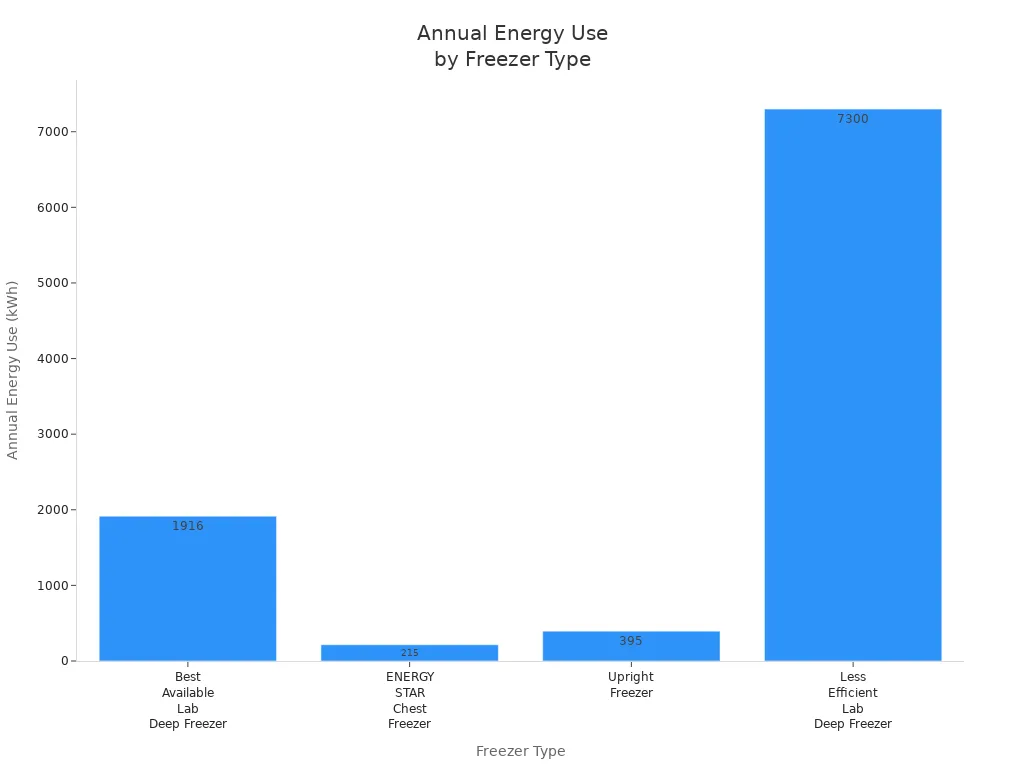
If you choose an ENERGY STAR certified laboratory deep freezer, you can use up to 33% less energy than a regular one. This means you pay less for power. Some freezers have special technology that changes how much energy they use depending on how full they are. Getting a new, energy-saving freezer can cut your energy use in half.
Tip: If you set your freezer from -80°C to -70°C, you can save up to 30% on energy costs and still keep your samples safe.
You need to keep your freezer free of ice so it works well. There are different ways to defrost:
Defrost System | Description | Advantages |
|---|---|---|
Manual Defrost | You empty and turn off the freezer to melt ice. | No need for automatic schedules. Protects sensitive items from temperature changes during moves. |
Auto Defrost | The freezer removes frost by itself on a schedule. | Saves time and keeps temperatures stable, protecting your samples. |
Manual defrost freezers need more work because ice builds up.
Auto-defrost freezers use heat to melt ice, but this can make the temperature go up for a short time.
Frost-free systems are best for sensitive samples because they keep the temperature steady.
The U.S. Centers for Disease Control says you should use a laboratory-grade freezer with a frost-free, automatic defrost cycle. Good airflow is important too. Do not pack your freezer too full. Leave space between boxes and shelves so air can move and keep the temperature even. Some freezers use special insulation to keep the cold in and the heat out.
You need to keep your samples safe from accidents and power problems. Laboratory deep freezers have many safety features. The table below lists common alarm types and what they do:
Alarm Type | Function |
|---|---|
Comprehensive Alarm Systems | Alert staff to any danger to sample integrity. |
Visual and Audible Alarms | Warn you if the temperature goes too high or low. |
High and Low Temperature Alerts | Tell you if the freezer is too warm or too cold. |
Rate-of-Change Alarms | Show if the temperature is changing slowly, which could mean a problem. |
Power Failure Alarms | Let you know if the power goes out. |
Door Ajar Alarms | Remind you to close the door to keep the temperature steady. |
Probe Failure Alerts | Warn you if a sensor is not working. |
Remote Alarm Contacts | Connect to building systems for notifications. |
Battery Backup Systems | Keep alarms working during power outages. |
You can also use lockable doors and remote monitoring to stop people who should not enter. Electronic locks and cameras help you control who goes in. Keep a list of everyone who enters or leaves. Only let trained people use the freezer. Check your safety rules often to make sure they work.
You must follow rules to keep your lab safe and legal. Laboratory deep freezers need to meet certain standards. The table below shows some important certifications:
Certification | Description |
|---|---|
GMP | Meets pharmaceutical industry standards. |
ISO | Follows global quality rules. |
CE | Meets European safety and performance standards. |
When you pick a laboratory deep freezer, check for these certifications. This helps you pass inspections and keeps your samples safe. Durability is important too. Some freezers last longer and work better than others.
A strong freezer saves you money because you do not have to buy a new one often. It also keeps your samples safe for many years.
You want a laboratory deep freezer that is easy to use. Good usability helps you work faster and make fewer mistakes.
Even the best equipment is not helpful if it is hard to use. If your team finds it confusing, they may make mistakes or skip steps.
Easy controls help you set the right temperature.
Digital displays show the temperature and warn you about problems.
Some freezers let you set up workflows for your lab.
Automated systems can help stop human mistakes.
Explosion-proof designs are for labs with flammable materials.
Remote monitoring lets you check the freezer from anywhere.
When you pick a laboratory deep freezer with these features, you make your work safer and easier. You also protect your samples and help your research.
Think about what your lab needs most. You want your samples to stay safe. You also want your work to go well. Check these things before you buy:
Find out what temperature your samples need.
Make sure the freezer has enough room for everything.
See if you can reach your samples easily and if the freezer fits in your lab.
Check if the freezer has good airflow and ventilation.
Decide if you need alarms or data tracking for extra safety.
You should also think about how steady the temperature is. Look at how much energy the freezer uses. Think about how often you will need to do maintenance. Some freezers have two compressors for better control. Others use less energy and save money over time.
Good help from the company matters a lot. You want a company that helps if something breaks. Look at the warranty and service choices:
Manufacturer | Warranty Coverage | Duration |
|---|---|---|
Thermo Fisher Scientific | Parts and Labor Warranty, Compressor Warranty | Varies |
True Manufacturing | 7-Year Labor, Parts, Compressor Warranty | 7 Years |
Many companies offer regular maintenance and have teams ready to help. A long warranty means you can trust the freezer to last.
Tip: Pick a Laboratory Deep Freezer from a company with good support and clear warranty terms.
You must follow safety and quality rules in your lab. Before you buy, check for these certifications:
Certification | Description |
|---|---|
ISO | International quality management standard. |
CE | Meets European safety rules. |
GMP | Follows good manufacturing practices. |
Keep a list of your equipment with serial numbers and calibration records. Make sure everything works well and meets the latest standards. This helps you pass inspections and keeps your samples safe.
You keep your samples safe by picking a freezer with steady temperature. Strong alarms help you know if something is wrong. Clear records show you are following safety rules. Reliable freezers help you pass checks and keep your lab safe. Make a checklist to remember important steps. Teach your team how to use the freezer. Keep track of what is inside to stop mistakes and help your lab do well.
First, unplug the freezer. Take out all the samples. Use mild soap and water to wipe the inside. Make sure you dry all the surfaces. Plug the freezer back in only when it is dry.
Check the temperature every day. This helps you find problems fast. It also keeps your samples safe.
Do not put chemicals and biological samples together. This keeps your research safe and stops contamination.
