


Introduction
The Free Piston Stirling Cooler (FPSC) has emerged as a transformative technology in the realm of thermal management, particularly within research settings. Unlike traditional cooling systems, FPSCs operate without a mechanical connection between the piston and the motor, leading to unique advantages in terms of efficiency, reliability, and versatility. As research continues to push the boundaries of science and engineering, understanding the efficiency of FPSCs becomes increasingly crucial. This article delves into the workings of FPSCs, evaluates their efficiency in research applications, and discusses their potential for future advancements in various scientific fields.
Understanding the Basics of Free Piston Stirling Coolers
A Free Piston Stirling Cooler (FPSC) is a type of cryocooler that operates on the Stirling cycle, a thermodynamic process involving compression and expansion of a gas to produce cooling. What distinguishes FPSCs from other Stirling coolers is their lack of mechanical linkage between the piston and the motor. The piston moves freely within the cylinder, driven by the pressure fluctuations of the gas, eliminating the need for a mechanical drive mechanism and enabling smoother operation.
FPSC technology offers a number of benefits over traditional cooling systems. These benefits include higher reliability due to fewer moving parts, less vibration, and the ability to operate in extreme environments. The efficiency of an FPSC is often a subject of research, particularly as it pertains to specific applications in scientific research, where temperature control is critical for experiments and instruments.
The Efficiency Factors of FPSCs
When assessing the efficiency of a Free Piston Stirling Cooler, several factors need to be taken into consideration. These factors directly influence the cooler’s performance in various research environments.
Thermodynamic Cycle and Operational Efficiency
The efficiency of an FPSC is largely determined by the thermodynamic cycle it operates on. The Stirling cycle, known for its high efficiency in comparison to other refrigeration methods, is central to the FPSC's function. However, achieving maximum efficiency in real-world conditions requires precise calibration of various components such as the regenerator, displacer, and piston.
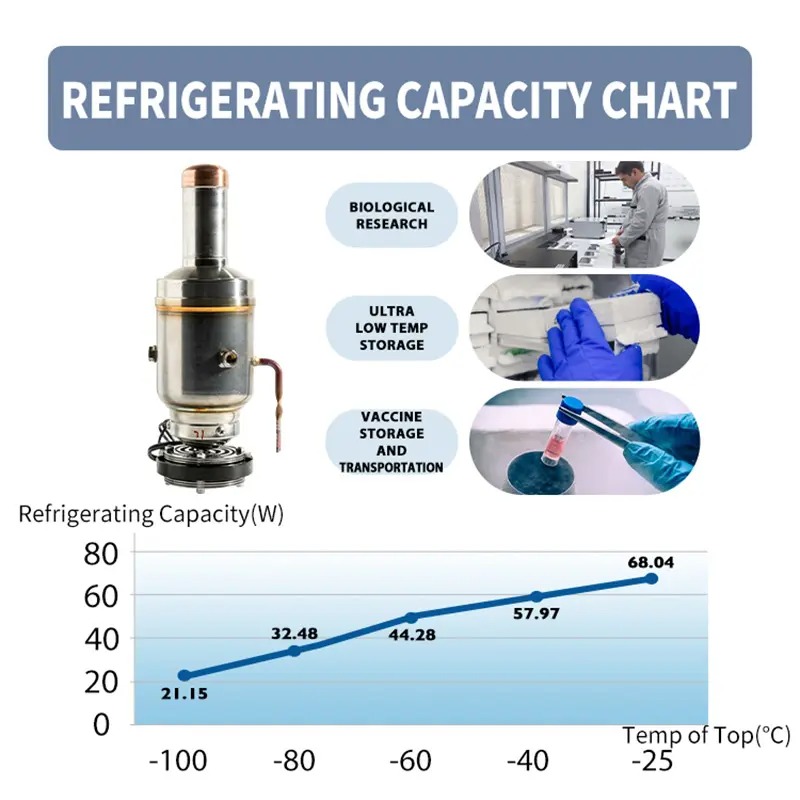
In many research applications, the efficiency of an FPSC must be balanced with the system's thermal output. As the temperature differential between the hot and cold reservoirs increases, the cooler becomes less efficient due to the limitations of the Stirling cycle. Therefore, understanding how to optimize these factors for specific research needs is essential for ensuring maximum efficiency.
Impact of Design and Material Selection on FPSC Performance
The design and materials used in FPSCs play a pivotal role in their overall efficiency. High-performance materials such as ceramics and advanced alloys are often employed in the construction of FPSCs to reduce thermal losses and improve heat transfer. The efficiency of an FPSC can also be affected by the geometric design of the cooler, as this influences how the gas flows through the system and how heat is exchanged between the different components.
Additionally, improvements in the materials used for the heat exchangers, piston seals, and regenerator structures have the potential to significantly enhance the efficiency of these systems. Research into new materials and designs is ongoing, with a particular focus on reducing friction and minimizing energy losses that can occur during the cooling process.
Power Consumption and Heat Rejection
For research applications, particularly those involving sensitive electronics or instruments, controlling power consumption is a key factor when evaluating the efficiency of a Free Piston Stirling Cooler. FPSCs are known for their low power consumption compared to other refrigeration methods, which is critical for applications where energy efficiency is important. However, it’s essential to consider the power consumption relative to the cooling capacity, as achieving a high cooling capacity with minimal power use remains a challenge.
Another important consideration is heat rejection. FPSCs generate heat at the hot end of the Stirling cycle, and the efficiency of heat rejection can have a direct impact on the overall performance of the cooler. Systems that effectively dissipate this heat to the surrounding environment tend to operate more efficiently, as the temperature gradient between the hot and cold ends remains optimal.
Cooling Capacity and Size Constraints
While FPSCs are highly efficient at certain temperature ranges, their cooling capacity is often a limiting factor in large-scale or industrial applications. However, in research settings where precision cooling is often required, FPSCs can offer the necessary cooling capacity without the need for bulky or inefficient systems. The compact nature of FPSCs allows them to be integrated into various scientific equipment, from cryogenic systems to semiconductor cooling solutions.
Moreover, the size constraints of FPSCs can present unique challenges for researchers. In some cases, the cooler’s capacity must be scaled to match the specific needs of the application, requiring careful balancing between efficiency and size.
Applications of FPSCs in Research
Free Piston Stirling Coolers have found applications in a wide range of research fields, including cryogenics, aerospace, electronics cooling, and more. The ability of FPSCs to provide precise, reliable cooling in a compact form factor makes them ideal for environments where temperature control is critical.
Cryogenics and Low-Temperature Research
In cryogenic research, where temperatures below 120 K are often required, FPSCs provide an efficient solution for maintaining low temperatures. Their high reliability and low vibration make them ideal for cooling delicate equipment and experiments that require minimal interference. Researchers in fields like superconductivity, material science, and quantum computing benefit from the stable and efficient cooling provided by FPSCs.
Space Exploration and Aerospace
FPSCs are also gaining traction in the aerospace industry, where efficient, lightweight cooling systems are essential for space missions. The need for robust, low-power cooling systems that can operate in the extreme conditions of space has made the FPSC an attractive option for cooling sensitive instruments on satellites and spacecraft. The absence of moving parts also reduces the risk of mechanical failure, a crucial factor for space exploration.
Semiconductor Cooling and Electronics
As electronic components continue to miniaturize, the need for efficient cooling solutions has become more pronounced. FPSCs provide an ideal solution for cooling semiconductors and other sensitive electronic components. Their ability to operate in compact spaces with minimal power consumption makes them particularly attractive for high-performance computing and data centers, where maintaining low operating temperatures is critical.
Challenges in Enhancing FPSC Efficiency
Despite the numerous advantages, there are still challenges associated with improving the efficiency of Free Piston Stirling Coolers, particularly for research applications. These challenges include the need for advanced materials, better thermodynamic optimization, and improved scalability for larger systems.
Material Innovation and Cost Considerations
One of the primary challenges in improving FPSC efficiency is the need for advanced materials that can withstand the demanding operating conditions of high-efficiency cooling systems. Materials must be capable of handling high temperatures, pressures, and cyclic stress while maintaining low thermal conductivity. These materials can be expensive, which poses a challenge for researchers and industries seeking to implement FPSCs in cost-sensitive applications.
Optimizing for Specific Applications
FPSC efficiency is also highly dependent on the specific application. A cooler optimized for low-temperature research may not be as effective for electronics cooling or aerospace applications. Researchers must tailor the design of the FPSC to meet the exact needs of their work, which can involve a trade-off between cooling capacity, size, and power consumption.
Conclusion
The efficiency of Free Piston Stirling Coolers in research settings has made them a cornerstone of many advanced scientific applications. While challenges remain in optimizing their performance for specific research needs, ongoing improvements in design, materials, and thermodynamics are pushing the boundaries of what FPSCs can achieve. As research continues to demand more precise and reliable cooling solutions, FPSCs will play an increasingly important role in ensuring the success of critical experiments and technologies.
FAQ
1. What is the primary advantage of Free Piston Stirling Coolers over traditional cooling systems?
Free Piston Stirling Coolers offer several advantages over traditional systems, including higher efficiency, fewer moving parts, reduced vibrations, and the ability to operate in extreme environments. These features make them particularly suitable for research applications that require precision cooling.
2. Can Free Piston Stirling Coolers be used in large-scale industrial applications?
While FPSCs are ideal for research and small-scale applications, their cooling capacity may be limited for large-scale industrial use. However, advancements in design and materials may make them more viable for broader industrial applications in the future.
3. How does the efficiency of an FPSC relate to its cooling capacity?
The efficiency of an FPSC is closely related to its cooling capacity. The cooler’s efficiency can decrease as the temperature differential between the hot and cold reservoirs increases. Researchers must balance cooling capacity with efficiency to achieve optimal performance for specific applications.
4. Are there any limitations to the use of Free Piston Stirling Coolers in space missions?
Free Piston Stirling Coolers are well-suited for space missions due to their compact size, reliability, and low power consumption. However, challenges related to material durability and heat rejection in a vacuum environment must be addressed to ensure long-term performance.
5. How are Free Piston Stirling Coolers used in cryogenic research?
In cryogenic research, FPSCs provide efficient and stable cooling for experiments that require extremely low temperatures. Their reliability and ability to maintain consistent cooling make them essential for fields such as superconductivity, material science, and quantum computing.


