


In recent years, the quest for sustainable cooling solutions has taken center stage, as industries and consumers seek energy-efficient technologies that can help mitigate climate change. Among these innovations, Free Piston Stirling Coolers (FPSC) stand out as a promising solution, offering significant advantages in terms of energy efficiency and environmental impact. This article explores the future of FPSC technology, how it works, its benefits over traditional cooling systems, and the role it can play in creating a sustainable future for cooling applications across various industries.
What is a Free Piston Stirling Cooler?
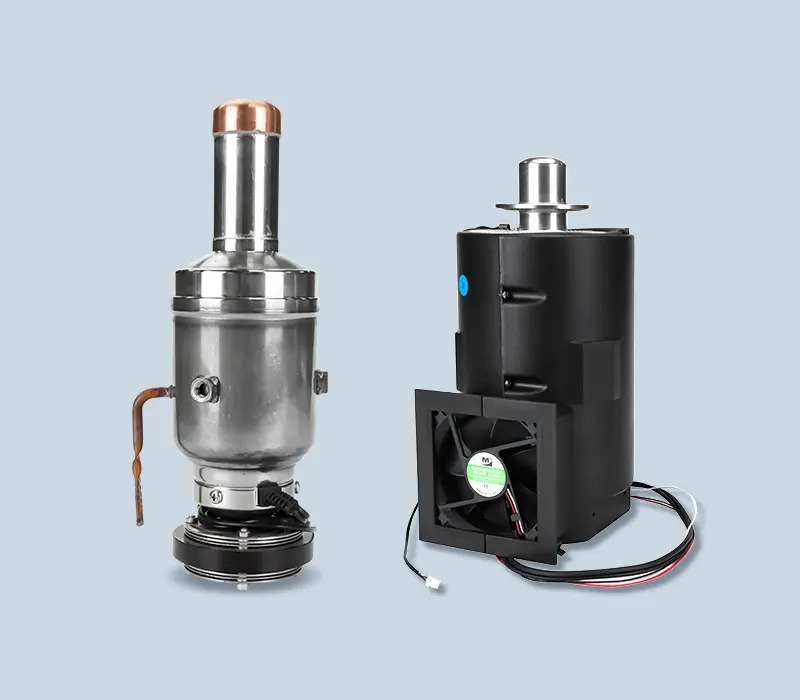
At its core, the Free Piston Stirling Cooler (FPSC) is a thermodynamic device that uses the Stirling cycle to transfer heat, providing an efficient and environmentally friendly cooling solution. Unlike traditional refrigeration systems that rely on compressors and refrigerants, FPSCs operate with a piston-free design, enhancing their reliability and efficiency. In this system, heat is transferred through the movement of a working gas (typically helium or hydrogen) that alternates between hot and cold cycles, absorbing and releasing heat in the process.
Free Piston Stirling Coolers have been around for several decades, but it is only recently that advancements in materials and design have made them a viable alternative for mainstream cooling applications. Their ability to provide cooling without the use of harmful refrigerants or high-energy consumption makes them particularly attractive for sustainable cooling solutions in both commercial and residential contexts.
How Do Free Piston Stirling Coolers Work?
The operation of a Free Piston Stirling Cooler is based on the Stirling engine cycle, which involves a series of temperature and pressure changes in a gas confined within a cylinder. The core components of an FPSC include the working gas, a regenerator, heat exchangers, and pistons. Here’s a simplified breakdown of how it works:
1. Compression and Expansion of the Working Gas
The key principle behind the FPSC is the compression and expansion of the working gas. In the cooling cycle, the gas absorbs heat from the area to be cooled, expands, and then passes through a regenerator where it loses heat. Once the gas has cooled, it compresses again, and the cycle repeats.
2. Heat Transfer Without Moving Pistons
In traditional Stirling engines, pistons are responsible for transferring energy. However, in the FPSC design, the system relies on a "free piston" configuration, where there are no mechanical connections to the piston. This eliminates friction and mechanical wear, significantly improving the efficiency and longevity of the cooler.
3. Regeneration for Efficiency
The regenerator in an FPSC plays a crucial role in enhancing the system’s efficiency. By allowing the working gas to recover some of its heat before it is compressed again, the system reduces the amount of energy required to cycle the gas. This heat exchange between the hot and cold regions helps to maintain a high coefficient of performance (COP) in the cooling process.
Advantages of Free Piston Stirling Coolers over Traditional Cooling Systems
Free Piston Stirling Coolers offer several distinct advantages over traditional cooling technologies such as compressor-based refrigeration systems. These benefits make them an attractive alternative for those looking to reduce their energy consumption and environmental impact.
1. Energy Efficiency
One of the main selling points of FPSCs is their exceptional energy efficiency. Compared to conventional refrigeration systems, which rely on compressors and vapor-compression cycles, FPSCs consume significantly less energy. Their ability to use waste heat from the environment, rather than relying solely on electrical energy, makes them ideal for sustainable cooling solutions.
2. No Harmful Refrigerants
Traditional cooling systems often rely on refrigerants that can contribute to ozone depletion and global warming. FPSCs, on the other hand, use environmentally friendly gases like helium or hydrogen as the working medium. This eliminates the need for chemical refrigerants, making FPSCs a much greener option for both residential and industrial applications.
3. Low Maintenance and Durability
Due to the free-piston design, FPSCs have fewer moving parts than conventional cooling systems. This significantly reduces mechanical wear and tear, resulting in longer operational lifespans and lower maintenance costs. Moreover, the absence of lubricants and chemicals in the system reduces the chances of contamination and breakdowns, which is particularly important for long-term sustainability.
4. Compact and Versatile Design
FPSC systems are highly versatile and can be adapted for a wide range of cooling applications. Their compact design makes them ideal for use in small spaces, such as consumer electronics, medical devices, and even space exploration. Additionally, FPSCs are capable of operating in extreme environments, such as remote locations or in space, where traditional cooling systems may fail or be impractical.
Applications of Free Piston Stirling Coolers
Free Piston Stirling Coolers have a broad range of applications across various industries, from consumer electronics to industrial cooling. As sustainability becomes a growing concern, FPSCs are increasingly being adopted in sectors where energy efficiency and environmental impact are top priorities.
1. Consumer Electronics
In the world of consumer electronics, cooling is a crucial component of device performance. FPSCs offer an energy-efficient solution for cooling high-performance devices like laptops, computers, and gaming consoles. Their small size and ability to operate without refrigerants make them a promising alternative to traditional cooling methods such as fans and liquid cooling systems.
2. Medical Devices
In medical applications, FPSCs are used for cooling sensitive equipment such as cryogenic devices, medical refrigerators, and laboratory instruments. These coolers are particularly valuable in situations where precise temperature control is necessary for preserving biological samples or pharmaceuticals.
3. Aerospace and Space Exploration
Free Piston Stirling Coolers are also finding applications in space exploration and aerospace technology. Their compact size, reliability, and ability to operate in harsh environments make them ideal for cooling spacecraft systems, satellite electronics, and other critical equipment in space.
4. Industrial Cooling
In industrial settings, FPSCs are used for cooling machinery, lasers, and even power plants. By utilizing waste heat and operating efficiently at scale, FPSCs provide a sustainable solution for large-scale cooling needs, helping reduce overall energy consumption in energy-intensive industries.
The Environmental Impact of Free Piston Stirling Coolers
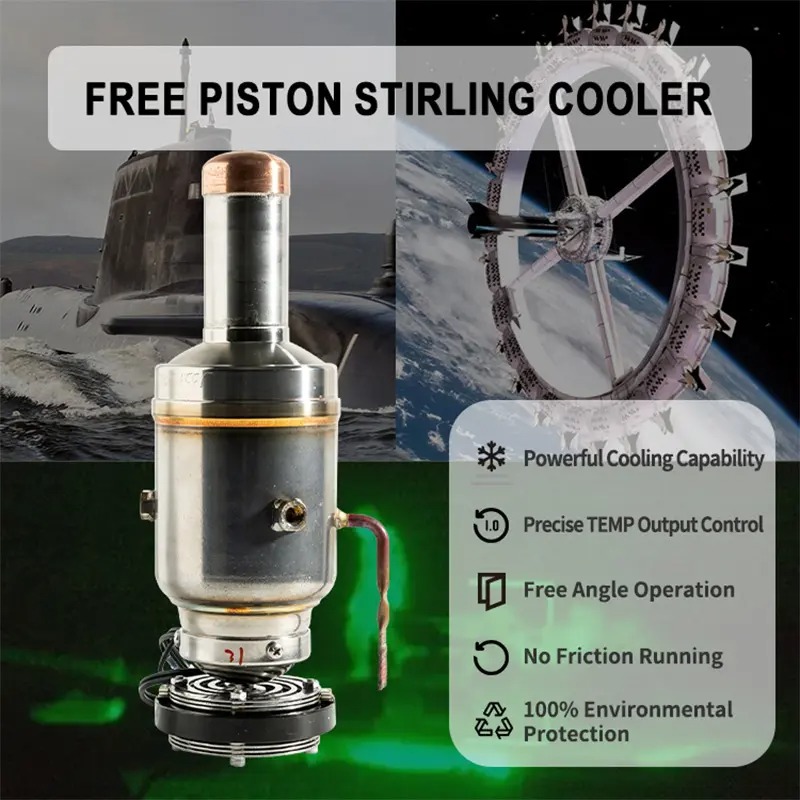
One of the most important factors driving the adoption of Free Piston Stirling Coolers is their positive environmental impact. Traditional cooling systems, especially those that rely on harmful refrigerants, contribute to global warming and ozone layer depletion. In contrast, FPSCs are environmentally friendly and help reduce the carbon footprint associated with cooling processes.
By eliminating the need for synthetic refrigerants and offering a highly efficient cooling solution, FPSCs can significantly decrease the overall environmental impact of cooling technologies. As businesses and consumers become more aware of the environmental cost of their actions, the demand for sustainable cooling solutions like FPSCs is likely to continue to rise.
The Future of Free Piston Stirling Coolers
Looking ahead, the future of Free Piston Stirling Coolers is bright. Ongoing advancements in materials, engineering, and design are likely to improve their efficiency, reduce their costs, and expand their range of applications. Researchers are focusing on optimizing the performance of FPSCs through better heat exchangers, working gases, and advanced control systems.
As governments around the world continue to implement stricter environmental regulations, the role of FPSCs in sustainable cooling will only grow. In addition to their environmental benefits, FPSCs’ potential for energy savings and low maintenance costs makes them an attractive option for industries looking to reduce operational expenses while minimizing their carbon footprint.
Conclusion
Free Piston Stirling Coolers represent the future of sustainable cooling, offering a highly efficient, environmentally friendly alternative to traditional refrigeration systems. With their energy efficiency, use of non-toxic working fluids, and low maintenance requirements, FPSCs are poised to become a dominant force in industries that rely on cooling technology. Whether in consumer electronics, medical devices, or aerospace applications, FPSCs hold the key to reducing the environmental impact of cooling systems while providing reliable, long-lasting performance.
FAQs
1、What is the difference between a Free Piston Stirling Cooler and a traditional refrigeration system?
A Free Piston Stirling Cooler operates without moving pistons and uses an environmentally friendly working gas to transfer heat, whereas traditional refrigeration systems rely on compressors and chemical refrigerants to cool the environment.
2、Are Free Piston Stirling Coolers energy-efficient?
Yes, Free Piston Stirling Coolers are highly energy-efficient, using less electricity compared to traditional cooling systems and making use of waste heat for better performance.
3、Can FPSCs be used in residential applications?
Yes, FPSCs can be used in residential applications such as cooling household appliances, electronics, and small refrigeration systems due to their compact size and energy efficiency.
4、What industries benefit most from Free Piston Stirling Coolers?
Industries that benefit from FPSCs include aerospace, medical devices, consumer electronics, and industrial sectors, all of which require reliable, energy-efficient cooling solutions.
5、Are Free Piston Stirling Coolers environmentally friendly?
Yes, FPSCs are environmentally friendly as they do not use harmful refrigerants like traditional systems and have a lower carbon footprint due to their energy efficiency.


