
Views: 0 Author: Site Editor Publish Time: 2026-01-08 Origin: Site


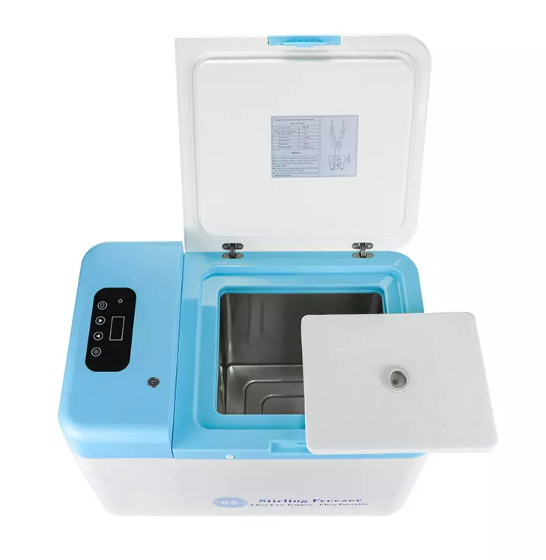
In today's research labs, maintaining ultra-low temperatures is crucial for sample preservation. Did you know that the right freezer can significantly cut down on energy consumption and costs?
Stirling Freezers are becoming essential in laboratory settings due to their advanced technology and energy efficiency. This article will explore the key benefits of using Stirling Freezers in labs, focusing on their reliability, cost savings, and role in maintaining sample integrity.
Stirling Freezers are powered by the Stirling engine, a unique mechanism that differs from conventional compressor-based cooling systems. Unlike traditional freezers, which rely on compressors to cool the system, Stirling engines use a closed-cycle process, where gas is alternately heated and cooled to generate the desired temperature. This eliminates the need for refrigerants commonly used in compressor-based systems.
The Stirling engine’s design features fewer moving parts, which results in higher reliability and less wear and tear. This makes Stirling Freezers a more durable option compared to traditional compressors, reducing the frequency of repairs and the associated maintenance costs.
Stirling Freezers operate based on the Stirling cycle, which includes compression, expansion, cooling, and heating of gas. In the cooling process, a heat exchanger and a displacer work together to move the gas between hot and cold cylinders. As the gas is heated, it expands and pushes the piston, while cooling causes it to contract. This continuous cycle ensures that ultra-low temperatures are maintained, making Stirling Freezers ideal for preserving sensitive samples.
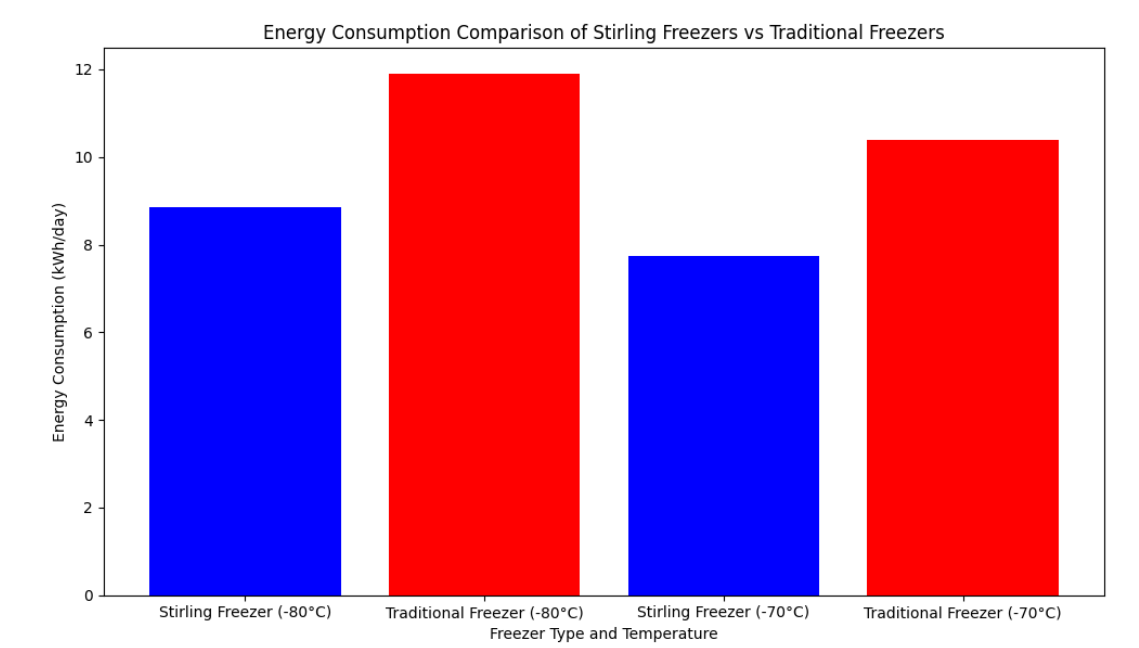
One of the major advantages of Stirling Freezers is their superior energy efficiency. These freezers consume significantly less power compared to traditional compressor-based models. The Stirling engine's continuous modulated cooling process eliminates the on-off cycling common in compressor systems, resulting in reduced energy usage. This energy efficiency leads to lower operating costs, which is especially important for laboratories with tight budgets and high energy demands.
Over the long term, Stirling Freezers help laboratories save money on energy and maintenance costs. The lower energy consumption directly translates into reduced electricity bills, while the absence of many moving parts minimizes maintenance requirements. Since Stirling Freezers are designed for durability, they have a longer lifespan, which further reduces long-term operational costs. Laboratories can therefore invest in a reliable, energy-efficient cooling solution that offers savings over time.
When compared to traditional compressor-based ULT freezers, Stirling Freezers provide notable energy savings. For example, a Stirling Freezer might consume up to 70% less energy, depending on the model and usage conditions. This efficiency is achieved through the Stirling engine's design, which operates smoothly with less energy input, offering laboratories a greener alternative to traditional cooling methods.
Freezer Type | Energy Consumption (kWh/day) | Energy Efficiency (W/L/Day) |
Stirling Freezer | 6.7 kWh/day | 9.00 |
Traditional Compressor-Freezer | 11.8 kWh/day | 11.89 |
Stirling Freezers are known for their precise temperature control, which is essential in maintaining the integrity of sensitive research samples. By offering consistent, stable cooling, these freezers prevent temperature fluctuations that could compromise the viability of stored materials. Whether storing biological samples, vaccines, or chemicals, a Stirling Freezer ensures that the required temperature is maintained, preventing degradation or spoilage.
Unlike traditional freezers, Stirling Freezers eliminate the on-off cycling of compressors, which often causes temperature spikes and dips. The absence of this cycling results in a more consistent temperature profile, ensuring that stored samples are not exposed to harmful fluctuations. This stability is particularly important in fields such as biotechnology and pharmaceuticals, where even small deviations from the desired temperature can lead to the loss of valuable materials.
Stirling Freezers utilize natural refrigerants, such as helium, which are far less harmful to the environment than the synthetic refrigerants used in traditional systems. The use of natural refrigerants significantly reduces the carbon footprint of Stirling Freezers, making them a more sustainable choice for laboratories looking to reduce their environmental impact.
The energy-efficient design of Stirling Freezers not only cuts down on electricity usage but also helps lower overall greenhouse gas emissions. Since these freezers produce less heat and use less energy, laboratories can reduce their overall carbon footprint. This makes Stirling Freezers an attractive option for institutions aiming to meet sustainability goals and reduce their environmental impact.
Stirling Freezers offer a compact design that makes them ideal for laboratories with limited space. These freezers are designed to provide maximum storage capacity without occupying excessive floor space. The unique layout of the Stirling engine, located outside of the sample storage area, allows for more room inside the freezer, enabling it to hold more samples in a smaller footprint.
Many Stirling Freezers come equipped with high-density racking systems, which further optimize storage capacity. These racks allow laboratories to store more samples in less space by stacking boxes vertically. By utilizing high-density storage, laboratories can maximize the use of available space, reducing the need for additional freezers and further saving on energy and costs.
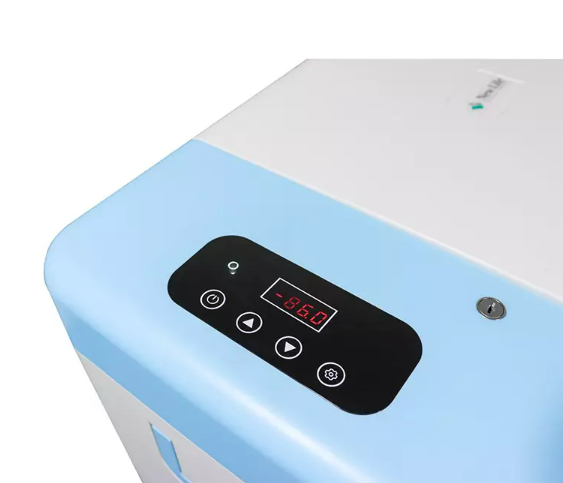
Stirling Freezers offer flexible temperature control across a wide range of temperatures, from -20°C to -86°C. This versatility makes them suitable for storing a variety of materials, from less sensitive biological samples to more delicate substances requiring ultra-low temperatures. Laboratories can use one Stirling Freezer for multiple applications, further improving space efficiency.
One of the key advantages of Stirling Freezers is their reduced need for maintenance. The free-piston Stirling engine has fewer moving parts compared to traditional compressor systems, which reduces wear and tear. This design minimizes the risk of mechanical failures, lowering maintenance costs and ensuring the freezer operates reliably over time.
Because Stirling Freezers have fewer moving parts and do not rely on oil or lubricants, they tend to last longer than conventional freezers. Their durability and reliability make them an excellent long-term investment for laboratories. By reducing the frequency of repairs and extending the service life of the equipment, Stirling Freezers offer excellent value to laboratories over time.
Maintenance Aspect | Stirling Freezer | Traditional Freezer |
Number of Moving Parts | Fewer | Multiple |
Need for Oil/Lubrication | None | Requires regular oil |
Frequency of Maintenance | Low | High |
In biomedical and pharmaceutical research, maintaining ultra-low temperatures is crucial for preserving the integrity of biological samples and vaccines. Stirling Freezers provide a stable environment for storing DNA, RNA, proteins, and other sensitive materials, ensuring that samples remain viable for long-term research purposes.
Stirling Freezers are also widely used in scientific research and biobanks, where large volumes of genetic material and other biological samples need to be preserved at ultra-low temperatures. The precision and reliability of Stirling Freezers make them ideal for these critical storage applications, helping researchers maintain sample integrity for future studies.
Many universities and medical laboratories rely on Stirling Freezers to store biological samples, clinical materials, and reagents. These freezers offer consistent performance, low operating costs, and energy efficiency, making them a preferred choice in academic and healthcare settings where reliable sample preservation is essential.
As technology continues to evolve, Stirling Freezers are expected to become even more energy-efficient and versatile. Innovations in cooling technology, digital monitoring, and automation will further enhance the capabilities of Stirling Freezers, making them even more indispensable to laboratories worldwide.
With the increasing emphasis on sustainability in laboratory operations, Stirling Freezers are well-positioned to meet the growing demand for energy-efficient, eco-friendly storage solutions. As more laboratories prioritize reducing their environmental impact, the adoption of Stirling Freezers is expected to rise.
Stirling Freezers are expanding beyond traditional laboratory settings, with potential applications in fields such as renewable energy, pharmaceuticals, and biotechnology. As the technology matures, Stirling Freezers may find new markets and applications, further solidifying their role as a leading cooling solution.
Stirling Freezers provide numerous advantages in laboratory settings. They offer exceptional energy efficiency, ensuring precise temperature control and reducing maintenance costs. These freezers are a sustainable, cost-effective solution for ultra-low temperature storage. Laboratories adopting Stirling Freezers can maintain sample integrity while lowering both operating costs and environmental impact. For laboratories seeking reliable storage solutions, Stirling Freezers are an excellent investment, backed by the expertise and commitment of Ningbo Juxin ULT-Low Temperature Technology Co., Ltd..
A: A Stirling Freezer uses a Stirling engine to maintain ultra-low temperatures. It operates with fewer moving parts compared to traditional compressors, offering energy efficiency and precise temperature control.
A: Stirling Freezers offer energy savings, reduced maintenance, and precise temperature control. They are ideal for preserving sensitive samples in laboratory settings, ensuring sample integrity over time.
A: Stirling Freezers use significantly less energy than traditional compressor-based freezers, which lowers operational costs and reduces environmental impact.
A: Yes, Stirling Freezers are more reliable due to their fewer moving parts. This reduces the likelihood of mechanical failures and minimizes maintenance needs.
A: Yes, Stirling Freezers can maintain a wide setpoint temperature range from -20°C to -86°C, making them versatile for various laboratory applications.
A: Laboratories should choose Stirling Freezers for their energy efficiency, low maintenance, and ability to maintain consistent temperatures, all of which help reduce costs and improve sample storage reliability.


